
Ottawa Public Health
Tales for Safer Trails
Project Type: Group Project
My Role: Graphic Designer
Timeline: January - April 2026
Challenge
Parents of young children often avoid conversations around substance use health due to stigma, discomfort, and the belief that the topic is irrelevant at an early age. From these findings, we asked ourselves:
How might we normalize substance use health as a routine part of parenting young children?
Research and Insights
Our research phase focused on understanding the emotional and social barriers surrounding substance use health conversations within families. Through empathy maps and iceberg model analysis, we explored the visible and underlying factors contributing to stigma, avoidance, and uncertainty among parents.
We also reviewed a variety of case studies and public health campaigns to explore creative and multidisciplinary approaches for communicating sensitive topics to children and families. These insights helped shape a solution that combined storytelling, illustration, education, and interactive activities in a way that felt approachable and accessible for both parents and children.

Empathy Maps
Helped us understand parents’ emotions, concerns, and challenges around discussing sensitive topics with their children.

Iceberg Model
Helped us uncover deeper beliefs, social stigma, and hidden factors influencing parents’ behaviors and reactions.

Case Studies
Helped us explore creative approaches for communicating sensitive topics through storytelling, visuals, and interaction.
Design Direction
During the ideation phase, we explored creative ways to make substance use health conversations more approachable and engaging for families. After brainstorming and concept development, we refined our initial storybook idea into printable one-pagers and a digital doodle experience based on client feedback and accessibility goals.
Initial Concept
Storybook
Storytelling is a familiar and engaging way for children to learn about different topics.
easier access
lower complexity
more practical implementation
Revised Concept
They are quick to download, easy to print, and can be used in short moments of interaction.
One-Pager
One-Pagers
The final solution was designed as a series of printable one-pagers that combine storytelling, interactive activities, and conversation prompts in a simple and accessible format. Parents can easily download, print, or use the digital version as a guided tool to support meaningful discussions with their children. We designed the layouts and assets for this project using Figma, Adobe Illustrator, InDesign, and Photoshop.
Easy to Print
Short Story
Interactive Activity
Conversation Starter
Characters
To create a sense of familiarity and connection across all age groups, we developed a recurring cast of characters that grow alongside the child audience. Milo and Mia appear throughout the one-pagers with age visual development and increasingly complex activities as they get older.
Guiding them is Patchy, a friendly bandage character who acts as a supportive guardian throughout the experience. Patchy helps introduce sensitive topics in a comforting, approachable, and child-friendly way.

Age 4-5
In the first story, Milo and Mia find a bottle and become curious about opening it. Patchy appears and teaches them the importance of asking a trusted grown-up or safe helper before touching unknown substances.
The accompanying activity invites children to color a scene where their mom safely helps them open the bottle, reinforcing the lesson through a simple and engaging interaction.


Age 6-8
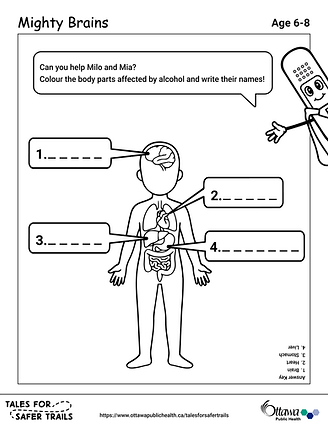
In the second story, Milo and Mia notice their mom drinking wine and ask why children are not allowed to drink it. With the help of Patchy, their mom explains how alcohol can affect different parts of the body in an age-appropriate way.
The activity encourages children to identify and label body parts to support learning through interaction and discussion.
Age 9-12
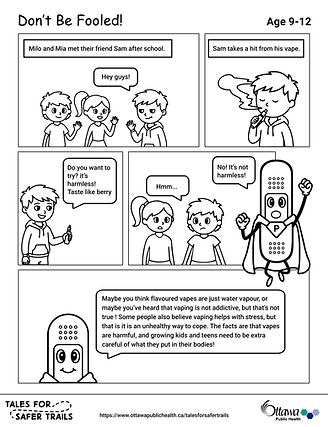
In the final story, Milo and Mia’s friend Sam offers them a vape and tells them it is harmless. Patchy steps in to help them question the misinformation and understand the risks of vaping. The related activity challenges children to identify myths versus facts based on the guidance provided throughout the story, encouraging critical thinking and informed decision-making.

My Role
Designed the visual identity and layout system for the one-pagers
Created illustrations and developed the character designs for Milo, Mia, and Patchy
Designed age-appropriate visual experiences across the three learning stages
Collaborated on research, ideation, and concept development throughout the project
HUBBUB 2026
As part of the project’s final outcome, our team also contributed to the Hubbub showcase by creating a promotional poster that highlighted the concept, characters, and educational goals of the campaign. The poster was designed to communicate the project in a visually engaging way while reflecting the approachable and child-friendly identity developed throughout the experience.
